
MensTrue Cycles
Directed and Misdirected Masculinity

Preface
During therapy, my psychotherapist often repeated the phrase ‘rupture and return’ to describe the gentle, and sometimes not so gentle, push and pull of my relationships. I instinctively understood this as a male thing, although he never said as much. It just seemed obvious to me that this was some kind of modus operandi of men. Not a choice, but an unconscious expression of how we relate. An intuitive need to connect, met with an equally intuitive need to recoil. Intimacy and exile, on a loop.
In Men Are from Mars, Women Are from Venus by John Gray, he described a similar idea he coined the ‘rubber band theory’: men experience intimacy, pull away, then snap back with a revived sense of connection.
Both are useful frameworks for understanding the male psyche, but I personally found them too broad to be useful in my everyday life. As my own awareness of them grew I began to notice layers and patterns that went far beyond the binaries of ‘rupture and return’ or ‘intimacy and exile’.
It took many, many iterations to get this version right, yet you’ll notice in the corner that I’ve declared this to be V1, or version 1. I don’t assume it to be complete or beyond revision. If it provokes genuine thought, and if those thoughts find their way back as considered feedback, it will no doubt evolve.
Itinerarium hominis
In his commentary in The Yoga-Sutra of Patanjali, translator Chip Hartranft compares consciousness to the frames of a film reel, discretely appearing one after the next, just fast enough to give the illusion of inescapable, unquestionable motion. Or life as we know it.
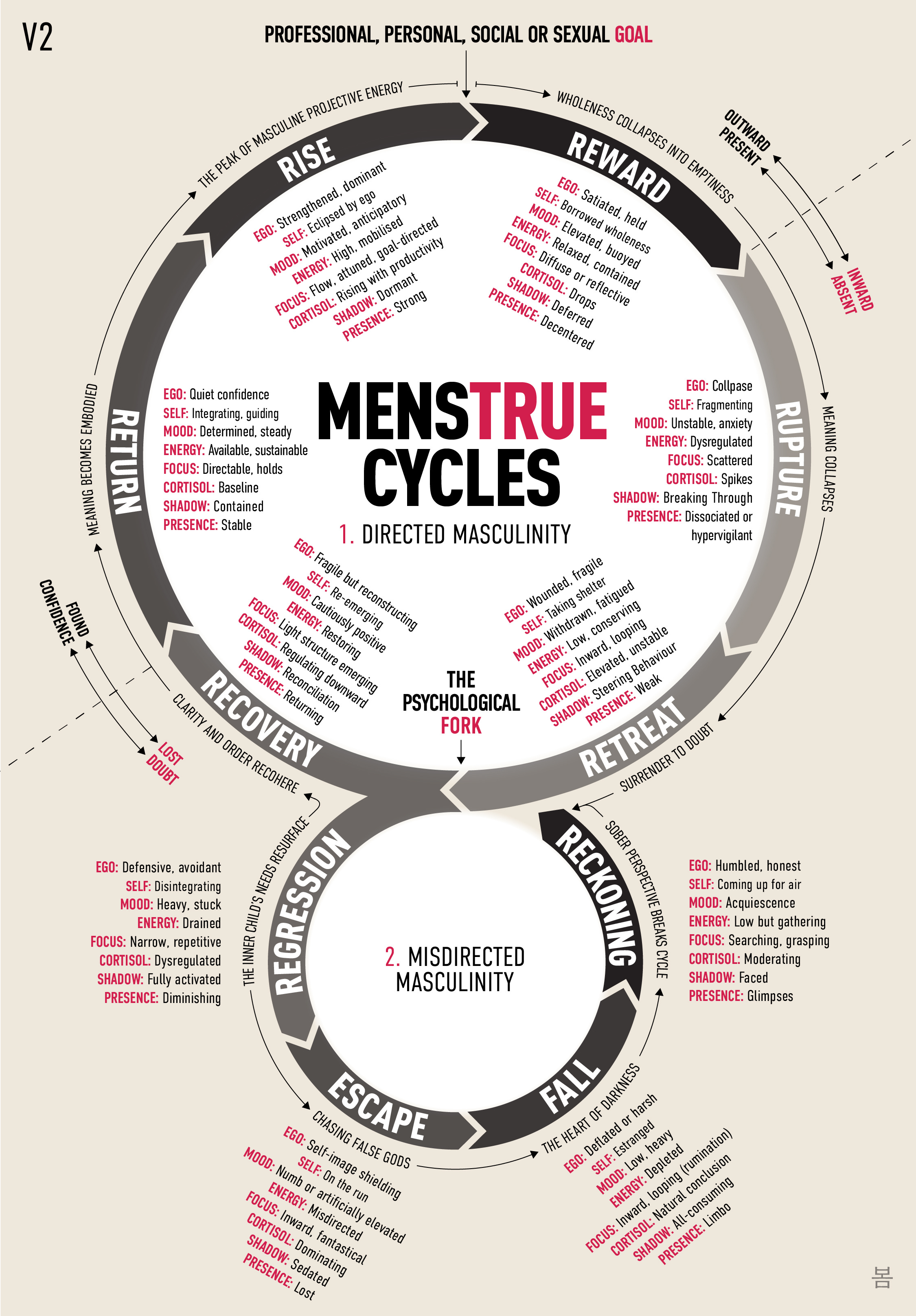
‘MensTrue Cycles’ is an attempt to help men see beyond the ‘film’ to the individual frames that govern, and at times enslave, our lived experience.
The title might read as a provocation, but I’m trying to make a serious point: our understanding of women as cyclical rests, quietly, on the assumption that men aren’t.
To be clear, I’m not belittling women’s menstrual cycles (although I am pointing out the irony of menstrual starting with the word ‘men’). Nor am I equating women’s cycles to men’s cycles. Women’s cycles are not the same as men’s. And besides, it’s not a competition. However, like women, our cycles are closely related to our underlying natures.
Of course, it shouldn’t be a shock that men have cycles. After all, it’s completely uncontroversial to say that men have a 24 hour testosterone cycle. Our bodies begin each day primed, or even aroused, for pursuit, challenge, and competition, before gradually shifting towards recovery and conservation in the evening. This is why men often wake up with an erection, a kind of biological awakening that ‘points’ us towards action.
It’s also uncontroversial to say that men have a sperm production cycle of between 70 and 90 days. Each cycle begins with the creation of new sperm cells and ends with their maturation and release. A quiet, invisible rhythm that most men never think about. And yet it never stops, quietly shaping mood, energy and drive in ways we barely understand and rarely question.
Some studies suggest there is also a longer term seasonal testosterone cycle, with levels slightly higher in late summer/autumn, and lower in winter/spring.
Yet, all too often, our society seems to view men and masculinity as one-dimensional, flat, constant and utterly predictable. A view best summed up by the idea that ‘men only think with their dicks’.
This view of men is incredibly damaging because it unwittingly holds men up to a standard that we can only experience fleetingly. Men are not consistent and predictable. We like to think masculinity is about showing up in a certain way, reliably, every time. That’s a goal. An ideal. But it’s not reality.
The reality is that we cycle. Endlessly. Sometimes torturously. Masculinity is not static. It is not one-dimensional. The popular understanding of men is a myth.
I know from personal experience that in my darkest moments (Fall), I feel utterly lost. I think many men today feel the same, because our lives don't live up to the myth. And when we feel lost, we need a map to find our way back. I hope this ‘psymbol’, as I’ve dubbed it, becomes that map. Not an excuse, but an unabashed typology of our lived experience.
But this isn’t just about men. It’s about the women who live in proximity to us too. For them, clinging to a view of masculinity that is constant, dependable and predictable can only lead to disappointment. When our moods, desires, energy levels and attentiveness shift (as they will) we create confusion, frustration and feelings of rejection. I hope this knowledge can set them free too.
The caveat
Whether my description of these various stages serves as a universal guide (my hunch) or as a personal confession, is for the reader to decide. I can’t speak for all men. It may well be that some high-functioning men never, or rarely, enter the lower ‘misdirected’ cycle. I hope that’s true. It’s something I continue to strive for. On the flip side, I fear there are men out there for whom the ‘misdirected’ cycle is the only cycle they know.
My belief, however, is that most men have some kind of blend of the two, with the proportions varying according to personality and circumstance. There will be men who’ve spent their entire lives in the upper cycle, who suddenly, through divorce, bereavement or illness, find themselves in the bottom one. Therefore, the ratio I have chosen for the two cycles is more symbolic than scientific.
Every man moves through these stages differently. High-functioning men likely cycle through the more challenging segments faster, optimising their time for Rise. Lower functioning men likely dwell in all the wrong places. The structure may be the same, but the details are yours.
And lastly, although the path looks linear, men can jump about and miss stages entirely, especially if the goal is missed.
Unravelling the stages
The psymbol is a continuous cycle, but I’m going to start at the top with Reward because I think it’s the most useful entry point. I’ll walk through the upper, ‘directed’ cycle first to give the lower, ‘misdirected’ cycle its proper context.
Note: when I refer to the ‘shadow’, this is a Jungian term meaning the parts of yourself you’ve rejected or hidden, which continue to shape your thoughts, feelings, and behaviour unconsciously.
Directed Cycle
REWARD: Wholeness Collapses into Emptiness
This is the goal. The prize. The summit we have been climbing towards. The thing we thought would complete us. And for a moment, we get it, and a brief sense of wholeness satiates the ego. Mood elevates as we float above the striving that brought us here. To others, we may seem lighter, more relaxed and easier to be around. But the feeling doesn’t last long. Soon, all that’s solid melts into air as we come back to earth with a bang. Boom: summit syndrome. A collapse that reveals an emptiness at the heart of what we were striving for.
RUPTURE: Meaning collapses
As ego collapses, so does meaning. The dream that once carried us forward suddenly feels hollow, distant, even alienating. Motivation thins. Energy folds. We grow quieter and harder to reach. For those we love, something has shifted. We seem distracted, irritable, absent. Conversations become shorter. Small things land harder than they should. Beneath the surface, old doubts are resurfacing. The shadow, dormant through Rise, stirs back to life.
RETREAT: Surrender to doubt
As the Rupture deepens, we instinctively withdraw. Quieter. Less available. Less responsive. We may stop sharing and begin trying to solve everything alone. Partners may experience this as distance. Friends might feel pushed away. At work, the person who was once decisive appears hesitant or disengaged. Beneath the surface, the shadow begins to steer our behaviour without our knowledge or consent. Withdrawal feels safer than participation. As we reach the psychological fork, it could go either way.
RECOVERY: Clarity and order recohere
This is the healthy path out of Retreat. Withdrawal turns to rebuilding. Nothing dramatic happens, but small signs of life return. The ego is still fragile, but reconstructing. Mood turns cautiously positive. People may notice greater openness and engagement. Rather than obsessing over what‘s wrong, attention shifts towards what can be done. This shift becomes the foundation for action. We sniff out a direction and quietly move towards it.
RETURN: Meaning becomes embodied
Action becomes natural and intuitive. Meaning no longer needs to be reached for. It moves through us. The ego is settled. Mood holds. Focus is directable. People may experience us as dependable, emotionally available and genuinely confident. They know where they stand with us. The turbulence has settled into quiet steadiness. From here, we build drive. Not from hunger or wound, but from a genuine sense of purpose.
RISE: The peak of masculine projective energy
This is simultaneously the pinnacle of masculine energy and its cliché. An energy that wants to push itself out into the world, for good or ill. We feel strong, motivated and mobilised. We are fully turned outwards to the world. Mood is elevated and anticipatory. Others might experience you as motivated, decisive and fully present. We initiate. We build. We lead. The enthusiasm may even become contagious. If, as they say, it’s all about the process and not the result, then this is perhaps the real reward. This is the ground we are always trying to get back to.
Misdirected cycle (after the psychological fork)
REGRESSION: The inner child’s needs resurface
The route from Retreat to Recovery isn’t always a smooth one. Rupture left a wound. Retreat deepened it. And if Recovery fails to fire, something older takes over. Not weakness. Survival. The inner child takes the wheel, driving us towards what once made the pain stop. In some men this might mean addiction or compulsion. The people around us may observe disproportionate reactions, with minor setbacks triggering major responses. There may be defensiveness and sensitivity to rejection. Mood heavies. Energy dissolves. The shadow is fully activated.
ESCAPE: Chasing false gods
We cannot sit with the regression, so we reach for relief. The goals of Rise feel humiliatingly far, so the ego hunts for smaller victories it can control. Facsimiles of the goals we really need. Sexual pursuit is replaced by porn. Heroic struggle is replaced by First Person Shooter (FPS) video games. Social hunger is replaced by social media. Physical exertion is replaced by doomscrolling. Our focus and energy loop inward, chasing the feeling of the goal rather than the goal itself. Others will notice our disengagement from real life, from the present moment. Our shadow is sedated, not faced. We are not really there.
RECKONING: Sober perspective breaks the cycle
During the Fall, the ego is humbled, stripped of its defences. Not defeated, but ready. Others may notice humility returning and defensiveness softening. We become more willing to listen, to admit mistakes, to acknowledge what needs to change. The excuses are beginning to disappear. Mood moves towards acquiescence and a certain willingness to end our suffering. Energy is low, but gathering. The shadow is finally faced, not fed. Presence returns in glimpses. This might not be a dramatic breakthrough, but rather a gentle turning.
Epilogue
One of the most fundamental truths in the Buddhist tradition is that suffering arises when we cling to things as though they are stable, lasting, or controllable, when in reality they are transient.
When I first read this, I presumed it referred to the external world. Clearly, life throws things at us, and pretending otherwise is going to cause suffering. But I think we need to get used to the idea that men are fighting a war on two fronts. Our bodies, minds, moods, and hormones are not stable. Clinging to them as if they were will only create more suffering. And in a world where men account for three quarters of all suicides, we should all take note.
My psymbol isn’t a manual for how men should be. It’s a reality check on how we actually are. The cycles are real. The patterns repeat. Most men will recognise themselves somewhere in these stages, even if they’d rather not.
But recognition isn’t the destination. It’s the beginning of a harder question: if we can see the pattern, can we disrupt it? If we know the Fall is coming, can we brace for it differently? Can we, with enough honesty and enough practice, shorten the cycles, or step outside them altogether?
I don’t think the answer is simple. But I believe the question is worth asking.
What I have noticed myself, is that understanding the frames of ‘my film’ gives me multiple awareness points, or way-markers, to allow me to recognise the pattern and guide myself through the more difficult stages, feeling less alone and more reassured.
As for stepping outside the cycles altogether, I don’t know. I’m not writing this from the other side. But I can perhaps provide some clues.
There is one such clue in the Bhagavad Gita. The god Krishna turns to the warrior Arjuna and says:
“The disciplined man, abandoning the fruits of action (Reward), attains lasting peace. The undisciplined man, driven by desire and attached to results (Reward again), becomes entangled in them (Regression, escape, fall)”
One way to interpret this is that Reward is the achilles heel for both cycles. Its presence in the top cycle guarantees the presence of the entire bottom one. A more Western way to think about this is the difference between intrinsic and extrinsic motivation.
Extrinsic motivation is doing something for validation. The grade, the salary, the approval, the status. The process is a vehicle. You tolerate it, perhaps at times you enjoy it, but the real prize lies elsewhere: in the outcome, the recognition, the promotion, the Likes. And when it arrives, it doesn’t hold. The glow fades faster than expected, forcing you to look for the next one.
Intrinsic motivation is doing something because the doing itself is the reward. I hinted at it earlier when I said: “If, as they say, it’s all about the process and not the result, then this is perhaps the real reward”. Intrinsic motivation holds that the work itself carries its own justification, motivation and value. A musician practising alone at midnight, with no audience. A writer who continues to write even when no one is reading his work. A carpenter who finesses the underside of a drawer that no one will ever see. The reward is the action. A simple test: would you still do it if no one ever knew?
Ultimately, MensTrue Cycles is an open invitation for men to come into communion with the frames of their film, as well as the shadow that lurks within them, because the man who understands these cycles is no longer ambushed by them.
This is amazingly well-put. I feel lucky for being among the first to read it.